Your EHR ends at the parking lot. Your readmissions don't.
EHRs see the clinic. Variate sees the field. Predict where care demand is heading, prescribe where to put staff, sites, and field teams, and prove the outcomes, on 200+ federal health variables, live in 30 days, with zero EHR integration.
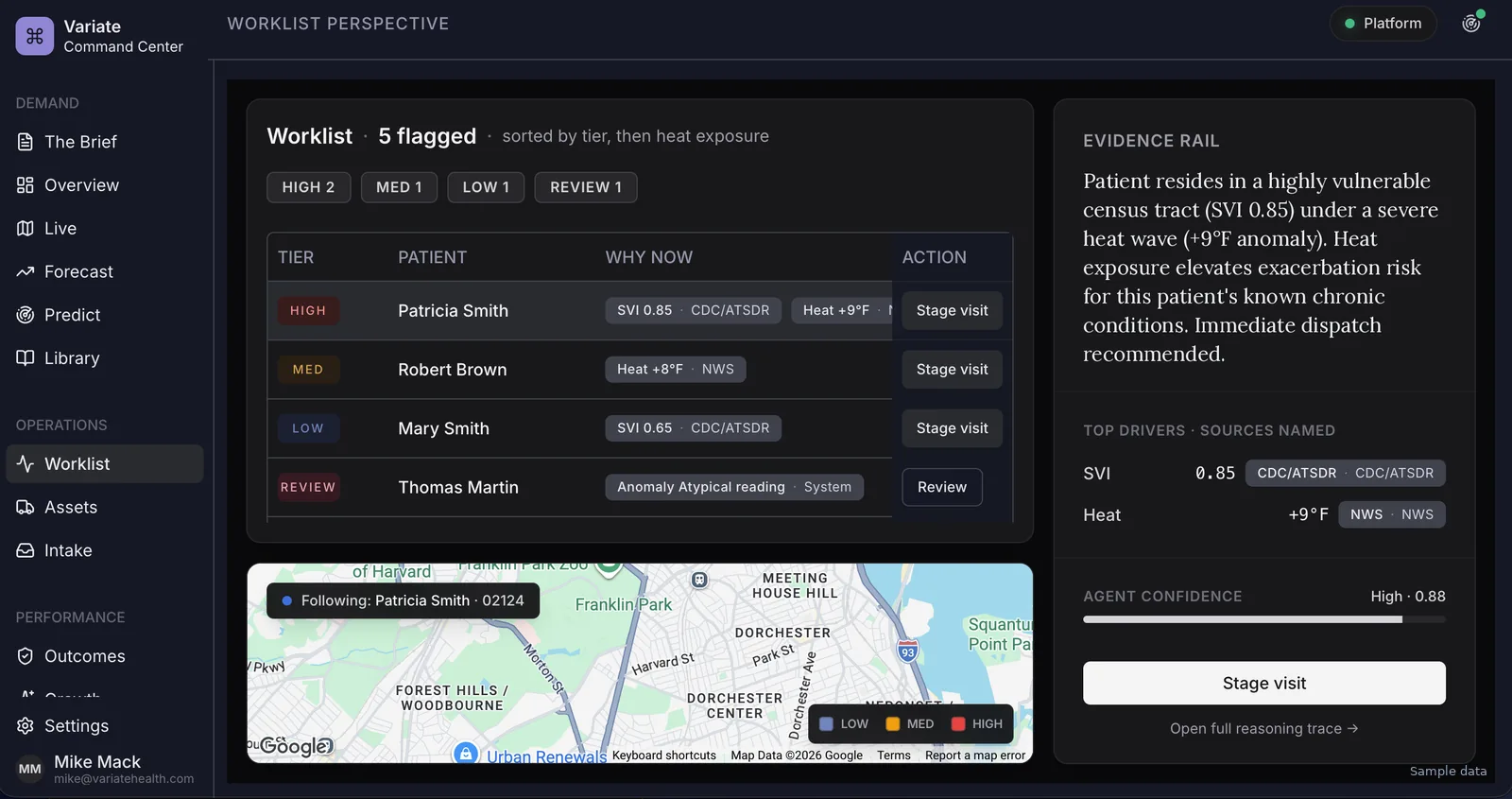
The worklist is the outreach record: who to reach, why now, and the evidence behind each flag.
THE SIX QUESTIONS
Every system you own answers one question.
You pay seven figures for each answer. Six questions run your enterprise. Five have owners.
Who is sick?
Your EHR
It has the patient's address, a text field on a form. What surrounds that address is blank in your system.
What is wrong?
Diagnostics
The lab says the A1C is 9.2. It can't say the patient lives where the next one is already guaranteed.
How sick are they?
Risk models
Your risk scores read the chart. The 200+ variables outside the chart never make it in.
When does it happen?
Care operations
Beds, blocks, and discharge timing dialed to the minute, until the patient leaves the building and your visibility ends.
How much does it pay?
Revenue cycle
You know what every encounter costs. Nobody can tell you what geography costs you.
WHERE?
Where risk concentrates. Where discharges go home to. Where capacity belongs next week. Where the market moves next year.
No system in the building answers it. Geography is the unowned variable in every decision the other five inform, and it's the variable Variate is built on. One question, asked at three time horizons: today's dispatch, next week's staffing, next year's markets.
Up to 80% of health outcomes are shaped by where people live, work, and play. Clinical care accounts for as little as 10–20%. The entire healthcare software industry is built on the 20%.
Variate is the operating layer for the 80%.
One engine. Three answers every operator needs.
Ask a question in plain English. About ten seconds later, the answer comes back as a map you can defend. No GIS team. No SQL. No integration project.
See demand before it arrives
Composite maps built from 200+ federal health variables show where need is concentrating, down to the neighborhood, before it shows up at your door.
Put resources where demand will be
Staff next week's surge before it hits, choose the next market to enter, route today's teams. One answer across all three.
Show your work
Defensible, data-backed evidence of field outcomes: the kind boards, agencies, and grant programs accept.
Every answer ships with a receipt.
AI that sounds confident is not the same as AI you can check. Every answer arrives with its work attached, so your team can challenge it before it drives a decision.
Every answer shows what went in, how it was weighed, and who signed off. Your team can question it before anyone acts on it.
Inspect one →Every prediction is written down the day it's made. What actually happened gets recorded next to it, including the misses.
See the record →Answers come back as how many people and where, not a score out of 100. A number like that can be checked.
Why counts →Ask in plain English. Get the answer in seconds.
Type a question the way you'd say it out loud. The engine weighs 200+ federal health variables and returns the answer: what's happening, what's coming, and where to act. The map is just how you see it.
Question to answer
Two fronts. One field.
Field intelligence your stack doesn't have
Your EHR ends at the parking lot. Variate adds the layer that sees past it: where discharged patients actually land, and which ones need the field first.
For Hospital Systems →New capability for new geography
Purpose-built for rural transformation programs: field-based capacity your region hasn't had before, designed for anti-supplanting compliance from day one.
For Rural Health & RHTP →Ask. See. Act.
Type the question in plain English
No query language, no GIS certification. Ask it the way you'd ask a colleague.
Get your answer in seconds
200+ federal variables, weighed into one precision answer, down to the neighborhood.
Send the field with evidence in hand
Route teams, choose geographies, keep the receipts your board and agencies can inspect.
If your patients live beyond your walls, let's talk.
One email, straight to the founder. If your system needs to see the field, this is the move.

Geography is healthcare's operating layer. Built by the person who answers the email: mike@variatehealth.com. One email. The founder reads it.